
Driveway Paving
New installs and replacements, including steep and switchback approaches.
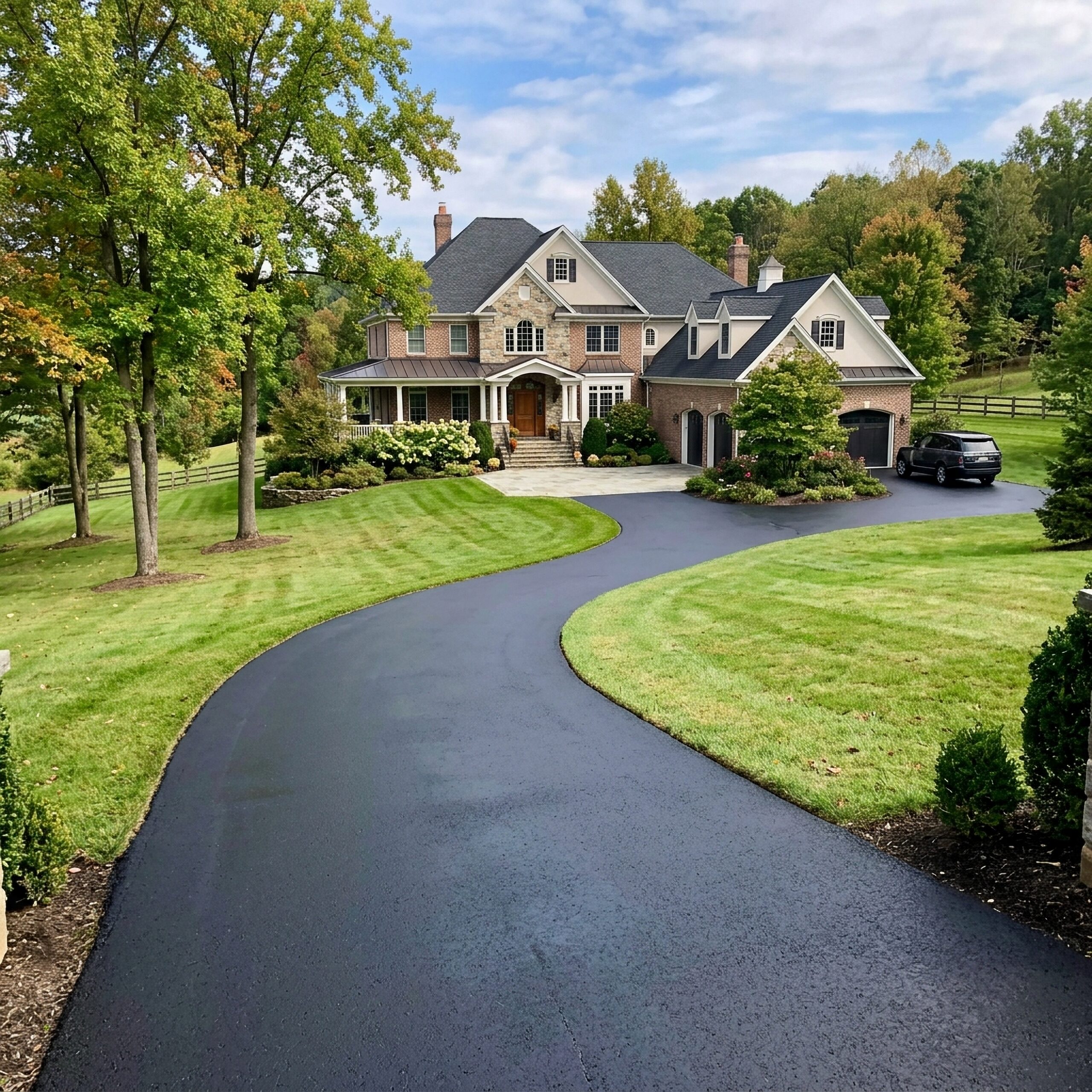
Driveways, lots, and repairs in New Hope and Solebury — steep river-side approaches, narrow historic lanes, and properties where getting equipment to the job is half the problem.
New Hope is among the more demanding places we work, and not because of the asphalt. The land falls steeply toward the river, many properties are reached by narrow private lanes with switchbacks and no turning room, and a good deal of the borough sits within a historic district where visible exterior work can carry additional review.
All of that has to be worked out before a number means anything. A driveway on a fifteen percent grade is a genuinely different job from the same square footage on the flat — it needs different mix decisions, careful compaction sequencing so the material does not move under the roller, and drainage designed for water arriving with real energy behind it.
On steep approaches, water running down the drive picks up speed and volume, and by the bottom it will scour anything it can. Cross-drainage part way down, proper crown, and somewhere for the water to discharge at the base are all necessary rather than optional. Paving a steep drive without them produces a channel down the middle within two seasons.
Properties in the lower-lying areas have their own consideration: water that arrives from the river rather than the sky. That affects what is worth building and where, and it is worth an honest conversation rather than paving something that will be underwater periodically regardless of how well it is built.
New installs and replacements, including steep and switchback approaches.
Shared and narrow lanes, crowned and cross-drained.
Cross-drains and discharge so water does not scour the drive.
Washouts, potholes, and failed sections rebuilt properly.
Crack filling and sealing every two to three years.
Inn, restaurant, and retail lots, scheduled around the season.
Those are the jobs worth looking at properly before quoting. Call (215) 997-1258 and we will come out.
Yes, and it is work we do regularly out that way. Steep drives need particular attention to compaction — material can move under the roller on a grade if it is handled carelessly — and to drainage, since water arrives at the bottom with real force. They cost more per square foot than a flat drive for good reasons, and any quote that does not reflect that has not accounted for the grade.
Cross-drainage, usually. Intercepting the water part way down and taking it off the drive stops the volume building to the point where it scours. Combined with proper crown so water sheds sideways rather than running the centre line, and a discharge point at the bottom that is not simply your neighbour’s property.
They can. Properties in a historic district may be subject to additional review for visible exterior changes, and the requirements are separate from ordinary permitting. It rarely prevents a driveway job but it can add time at the front end, so check with the borough before you plan around a date.
We look at it and work out the answer, which is usually smaller equipment, shuttling material in, or hand-laying the tightest sections. What we will not do is quote it as a straightforward job and then discover the problem on the morning. Access is part of the assessment, not a surprise.
Tell us what you're working with and we'll get back to you within one business day — usually faster. Or skip the form and call (215) 997-1258.